


For many of us, education once meant memorizing textbooks, repeating answers, and scoring marks in exams. Classrooms focused on remembering facts rather than understanding ideas. While this approach worked in the past, it is no longer enough for today’s fast-changing world.
The emphasis of modern education is now more on thinking than memorization. Students are encouraged to comprehend concepts, ask questions, and apply knowledge in real-life circumstances rather than being asked to memorize facts. This change is important since today’s students need to be ready for real-world difficulties, careers, and lifelong learning in addition to tests. This contemporary method of learning is widely supported by platforms such as SkillsBiz Education.
Traditional Education and the Memorization Model
Rote learning was a major component of traditional educational systems. Definitions, formulas, and solutions were supposed to be committed to memory by students, frequently without their complete comprehension. Because it was simple to assess and gauge through tests, this approach was thought to be successful.
But memorizing has obvious drawbacks. After tests, students frequently forget material and find it difficult to use it in real-world contexts. Memorized solutions are rarely sufficient when confronted with novel problems. The gap highlighted the need for an improved teaching strategy that prioritizes comprehension and reasoning over memorization.
The Changing Needs of Today’s World
The modern world requires people who can think critically, solve problems, and be flexible. Job responsibilities are shifting, technology is developing quickly, and new skills are always needed. Success now requires more than just memorizing facts.
People who can swiftly pick up new skills, analyze situations, and make wise decisions are now sought after by employers and industries. Because of this, contemporary education emphasizes the development of critical thinking abilities that enable students to remain relevant and self-assured in any setting. This is made possible via platforms such as SkillsBiz Education.

What Thinking-Based Learning Really Means
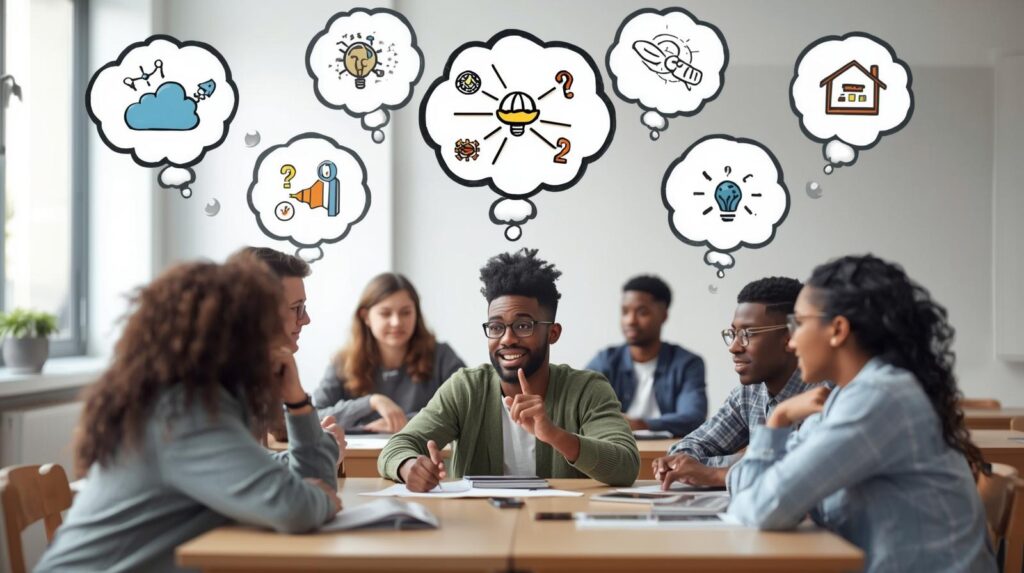
Understanding what you learn and knowing how to apply it is the essence of thinking-based learning. Students learn to ask “why” and “how” questions rather than memorizing answers. They emphasize logic, problem-solving, and applying concepts to actual circumstances.
This method promotes active learning and curiosity. Students actively participate in the learning process rather than only being passive listeners. By creating educational opportunities that emphasize comprehension, clarity, and real-world application, SkillsBiz Education supports this approach.
How Thinking Improves Long-Term Learning
Learners retain topics longer when they have a thorough understanding of them. Because knowledge is linked to experience and meaning rather than just repetition, thinking-based learning improves memory.
Learners who concentrate on comprehension are able to apply knowledge in various contexts and recall it with ease. Deeper learning and improved academic and professional performance result from this.
Developing Problem-Solving and Decision-Making Skills
Thinking-focused education supports learners in problem-solving, option evaluation, and decision-making. Students learn how to approach new issues logically rather than depending on solutions they have committed to memory.
These abilities to solve problems are crucial in both personal and professional contexts. Students who are taught to think critically are more self-assured and productive when it comes to making decisions in daily life or overcoming obstacles at work.
The Role of Teachers in Modern Education
Instead of only imparting knowledge, teachers in today’s classrooms serve as mentors and advisors. They promote dialogue, curiosity and autonomous thought. Learners are inspired to investigate concepts, exchange viewpoints, and engage in group learning.
Students develop both intellectually and emotionally in this encouraging learning atmosphere. By offering organized, learner-focused content that promotes engagement and critical thinking, learning systems like SkillsBiz Education also assist educators.

Technology and Modern Learning Methods
Thinking-based education heavily relies on technology. Students may study at their own speed and delve deeper into subjects thanks to digital tools, online courses, and interactive learning platforms.
Through case studies, real-world examples, and hands-on activities, students may put what they learn into practice right away. SkillsBiz Education makes education more interactive, useful, and thought-provoking by utilizing contemporary learning resources.
Benefits of Thinking-Focused Education for Students
Confidence, creativity, and communication abilities are all enhanced by thinking-focused schooling. Learners become more flexible, expressive, and receptive to new ideas.
Students form a habit of lifelong learning rather than studying merely to pass tests. They are better equipped to succeed in school and in life in the long run with this mentality.
How Modern Education Prepares Learners for Careers
Academic knowledge alone is not enough for modern careers. Critical thinking, problem-solving, teamwork, and flexibility are all highly valued by employers.
Thinking-based education facilitates students’ seamless transition from the classroom to the workplace. It allows individuals to confidently manage obligations in the real world. By matching education to industry demands and practical skills, SkillsBiz Education closes this gap.

Challenges in Moving Beyond Memorization
Moving away from memorizing can be difficult, despite its advantages. This shift is frequently slowed down by exam pressure, rigid study habits, and scarce resources.
However, these difficulties can be addressed with progressive adjustments, helpful teaching strategies, and learner-friendly platforms. Institutions and students can successfully implement thinking-based learning with continuous work and the appropriate support from platforms like SkillsBiz Education.
The Future of Education: Learning That Empowers
Personalized, skill-based, and thinking-oriented learning is the way of the future for education. Education systems are changing to emphasize lifelong learning, practical skills, and individual capabilities.
These days, understanding how to think is more important than simply remembering facts. By emphasizing comprehension, logic, and application, students develop self-assurance, competence, and independence.
Students who receive a thinking-based education are more prepared for life than just tests. Learners can develop skills that are really important in today’s society with the help of platforms like SkillsBiz Education.
FAQs
Why is thinking more important than memorization in modern education?
Thinking helps learners apply knowledge in real-life situations rather than just recalling facts.
Does memorization still have any role in learning?
Yes, memorization supports learning, but it should not replace understanding and thinking.
How does thinking-based education help students in exams?
Understanding concepts improves clarity and confidence, leading to better exam performance.
Can all subjects be taught with a thinking-focused approach?
Yes, critical thinking can be applied across subjects, from science to humanities.
How can students develop thinking skills on their own?
By asking questions, reflecting on what they learn, and practicing problem-solving regularly.
How does modern education support lifelong learning?
Thinking skills help learners adapt, grow, and continue learning throughout their lives.