


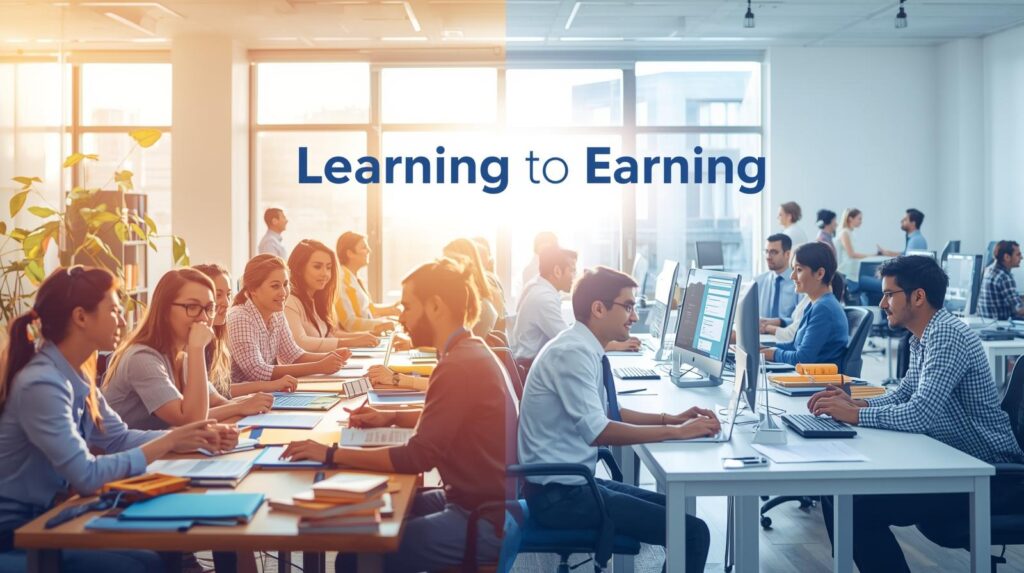
Imagine a recent graduate who holds a degree but has difficulty securing stable employment. Conversely, another learner who possesses practical skills secures employment rapidly, experiences professional growth, and earns a consistent income. This straightforward distinction emphasizes the direct effect of learning—when paired with the appropriate skills—on income and economic stability.
While education has always been associated with improved prospects, in the present day, simple learning is insufficient. The genuine link is found among learning, employability, and economic strength. When individuals develop relevant skills, they become more productive, confident, and employable, contributing not only to their personal growth but also to the economy around them.
converting their acquired knowledge into real-life value. This blog examines the role of skills in connecting learning to earning, improving economic systems, and emphasizes the importance of skill-based education—backed by platforms such as SkillsBiz Education—in creating a robust and sustainable economy.
Understanding the Link Between Skills and Economic Growth
Economic growth does not happen in isolation. It is powered by individuals who can execute tasks effectively, fix issues, and adjust to new circumstances. Skilled individuals contribute more effectively to businesses by improving productivity, quality, and innovation.
When employees are well-trained:
-
Businesses perform better
-
Resources are used efficiently
-
Errors are reduced
-
Customer satisfaction improves
At a broader level, work based on skills enhances local and national economies. A skilled workforce attracts investment, supports entrepreneurship, and encourages innovation. Countries and communities that prioritize skill development investment often see enhanced employment rates and supported economic resilience.
Learning vs. Earning: Bridging the Gap
Traditional education focuses heavily on academic knowledge, but industries today look beyond degrees. They are looking for individuals who can put their knowledge into practice.
While practical skills allow for action, academic learning fosters understanding. This inequality accounts for the difficulties many graduates experience when trying to join the workforce, even after years of schooling.
Skill-based learning helps bridge this gap by:
-
Aligning education with industry needs
-
Preparing learners for real job roles
-
Making transitions from education to employment smoother
Platforms like SkillsBiz Education focus on this connection, ensuring learners gain job-relevant skills that support real earning opportunities rather than just theoretical knowledge.

How Skills Improve Individual Earning Potential
Skills directly influence how much and how well a person earns. Skilled professionals often access better job roles, negotiate higher salaries, and enjoy greater job security.
Continuous learning allows individuals to:
-
Upgrade their roles
-
Stay relevant in changing industries
-
Move confidently between careers
Along with income, skills contribute to building confidence and enhancing career mobility. Knowing that they can adapt and learn, individuals feel empowered to seek out growth opportunities. Such confidence plays a part in personal stability and financial well-being over the long haul.
Skill Development and Workforce Productivity
A skilled workforce is a productive workforce. Employees who understand tools, processes, and best practices perform tasks faster and more accurately, helping organizations grow and remain competitive.
Well-trained employees contribute through:
-
Faster task completion
-
Better decision-making
-
Improved quality of work
-
Stronger teamwork and communication
Increased productivity results in improved business performance, thereby bolstering economic output. This link shows the necessity of investing in skill development for personal advancement as well as for broader economic progress.
Skills as a Driver of Employment Opportunities
Modern hiring has shifted toward skill-based recruitment. Employers prioritize what candidates can do rather than where they studied.
Skill-based hiring:
-
Increases employment rates
-
Expands opportunities across industries
-
Reduces reliance on limited traditional roles
When people develop practical skills, they are no longer restricted to a single career path. This flexibility reduces unemployment and supports a more inclusive and dynamic economy.

The Role of Education Platforms in Economic Development
Education platforms play a critical role in closing skill gaps. Structured learning programs help learners gain clarity, confidence, and competence.
SkillsBiz Education emphasizes practical learning that is pertinent to the industry and equips learners for actual challenges they will face. SkillsBiz Education aids individuals in developing job-ready skills that bolster economic strength by providing education that is both accessible and centered on skill development.
Such platforms ensure that learning is not just informative, but transformative—for careers and economies alike.
Skills and Economic Resilience in a Changing World
Economic conditions change rapidly due to technology, global trends, and market demands. Skilled individuals adapt better to these changes because they can reskill and upskill when required.
Reskilling helps:
-
Individuals stay employable
-
Businesses remain competitive
-
Economies recover from disruptions
Skills also support innovation by enabling people to create new solutions, services, and businesses. This adaptability strengthens long-term economic stability.
Skill-Based Careers and Emerging Economic Sectors
Today’s economy relies heavily on adaptable skill sets. New sectors are growing because skilled professionals are available to support them.
Key areas driven by skills include:
-
Digital services
-
Data-driven roles
-
Online business and freelancing
-
Technology-supported industries
These fields provide careers that are prepared for the future and demonstrate the role of ongoing education in economic growth. SkillsBiz Education equips learners for entry and advancement in these developing industries.

Learning at Every Stage: Skills Beyond Formal Education
Learning does not end with a degree or certificate. Lifelong learning is essential for staying relevant in today’s economy.
Skill-building supports:
-
Career advancement
-
Role changes
-
Professional growth at any stage
Whether someone is starting out or switching careers, platforms like SkillsBiz Education make skill development accessible, practical, and aligned with real economic needs.
Challenges in Skill Development and How to Overcome Them
Many people hesitate to develop new skills due to:
-
Lack of guidance
-
Fear of failure
-
Time constraints
Structured learning, mentorship, and consistent practice help overcome these barriers.
Long-Term Economic Benefits of a Skilled Population
A skilled population strengthens national productivity and economic health. It leads to:
-
Lower unemployment
-
Higher income levels
-
Sustainable economic growth
Economies develop greater competitiveness, innovation, and resilience when individuals possess skills. Lasting economic value is created by education systems that give priority to skills.
Skills connect learning to earning. They turn education into opportunity and effort into earnings. We create more robust careers, enterprises, and economies by equipping individuals with practical skills.
Utilizing money into skill-based learning via platforms such as SkillsBiz Education is a contribution to economic strength, stability, and growth in the future. To start the journey from learning to earning, you need the right skills.
FAQs
How do skills influence economic growth?
Skills improve productivity, employment, and innovation, strengthening economic performance.
Why is skill-based learning important today?
Because industries value practical abilities that directly impact work performance.
Can skills improve earning potential without formal degrees?
Yes, job-ready skills often matter more than degrees in modern hiring.
How does continuous learning support economic stability?
It helps individuals and businesses adapt to change and remain competitive.
What role do education platforms play in skill development?
They provide structured, accessible, and industry-relevant learning paths.