



The concept of machines thinking like humans seemed like science fiction not so long ago. People thought that robots will take over the world, replace people in the workplace, and make their own decisions. But these days, artificial intelligence, or simply AI, has subtly permeated daily life. AI is already at work in the background, from smartphones that advise the next word you enter to websites that suggest jobs, movies, or courses.
AI is exciting and full of opportunities for many. Others find it frightening, particularly in terms of employment. It’s becoming more and more usual to ask questions like “Will AI take my job?” and “Do I need technical knowledge to survive in the future?” AI is actually more than just replacing humans with machines. It is about how the nature of work is evolving and how people may change, develop, and continue to be valuable.
This is when it becomes crucial to comprehend AI in plain, useful terms. In addition to teaching students what AI is, platforms like as SkillsBiz Education also teach them how to develop abilities that will be useful in a world driven by AI. We must first define artificial intelligence clearly, without technical jargon, in order to fully comprehend what AI means for employment.
What Is Artificial Intelligence in Simple Words?
Machines or software programs created to carry out tasks that often need human thought are referred to as artificial intelligence. This includes making judgments, identifying patterns, comprehending language, learning from experience, and even forecasting results. AI, however, lacks human thought and emotion. Rather, it operates using human-created data, rules, and algorithms.
Imagine training a youngster to recognize fruits to help clarify this. You constantly display images of oranges, bananas, and apples until the child can identify them. AI learns similarly. In order to see patterns and make judgments based on what it has learnt, it is trained on vast volumes of data.
In actuality, AI is already a part of everyday professional life. Examples of AI in operation include chat systems for customer service, email filters that eliminate spam, and navigation apps that recommend quicker routes. Knowing this enables humans to view AI as a tool rather than a danger and helps allay worry.

Why AI Is Becoming Important in the Workplace
AI is expanding quickly because it makes organizations operate more quickly, intelligently, and effectively. Every day, organizations deal with enormous volumes of data. It would take too much time and effort to analyze this data by hand. AI assists by swiftly digesting data and spotting trends that people might overlook.
AI also lessens repetitious tasks. Employees may concentrate on more important and creative work by automating tasks like data entry, scheduling, and simple analysis. As a result, businesses can increase output while workers can acquire more valuable skills.
But employment positions are also altered by this transition. AI transforms employment rather than completely abolishing them. Instead than competing with technology, people are now expected to collaborate with it. Because of this, acquiring flexible, useful skills is becoming crucial—a notion that SkillsBiz Education firmly emphasizes.
The Fear Around AI and Job Loss
Uncertainty is typically the source of fear surrounding AI. Every significant technical advancement, from computers in offices to machines in factories, has historically caused anxiety about losing one’s work. But as time went on, new positions appeared and the nature of employment changed.
The same tendency is seen in AI. Certain duties will vanish, particularly those that are rule-based and repetitious. But new positions that call for human judgment, creativity, communication, and emotional intelligence are already starting to emerge. Jobs are changing rather than completely disappearing.
Customer service positions, for instance, are evolving. AI chatbots answer simple questions, but human agents concentrate on complicated problems that call for judgment and empathy. In a similar vein, marketing experts increasingly collaborate with data-analyzing AI systems, freeing up humans to concentrate on strategy and narrative.
How AI Is Changing Different Types of Jobs
The influence of AI extends beyond a single sector. It has an impact on nearly every industry, including business, finance, healthcare, and education. But the change appears differently in every industry.
By modifying content according to student performance, artificial intelligence (AI) in education helps customize learning. Instead of being replaced, teachers acquire new perspectives to better assist pupils. AI helps physicians in the healthcare industry by evaluating medical data, but humans still make the final judgments.
AI is used in business to analyze financial risks, consumer behavior, and market trends. However, human talents continue to play a major role in leadership, connection building, and strategic thinking. These illustrations demonstrate how AI serves as a helper rather than a substitute.
Skills That Will Remain Important in the AI Era
The value of human-centered talents increases as AI takes on more complex and repetitive activities. It is challenging to automate abilities like communication, critical thinking, creativity, flexibility, and problem-solving. These skills enable people to interact with others, make moral decisions, and analyze information.
Digital awareness is also increasingly crucial. This does not imply that everyone has to learn how to program. Instead, for the majority of positions, knowing how technology functions and how to apply AI tools efficiently suffices.
A business professional who knows how AI-based analytics tools operate, for example, can make better decisions than someone who stays completely away from technology. Building this balance between human talents and digital understanding is the main goal of SkillsBiz Education.
The Role of Reskilling and Upskilling
The necessity of ongoing learning is among the most significant developments brought about by AI. Once acquired skills are insufficient for a full career. Professionals need to continuously refresh their skills as job positions change.
While upskilling entails enhancing current abilities to remain relevant, reskilling entails learning new skills for a different role. In an economy powered by AI, both are crucial. Employees that demonstrate a willingness to learn and adapt are increasingly highly valued by businesses.
AI as an Opportunity, Not a Threat
When properly understood, AI creates new opportunities rather than barriers. It enables people to shift their attention from monotonous activities to strategic, creative, and meaningful work. Additionally, it opens up new employment options in fields including technology management, data interpretation, AI ethics, and digital strategy.
Additionally, AI gives individuals and small enterprises access to capabilities that were previously exclusive to huge organizations, enabling them to compete on a broader scale. A more diverse labor market is produced by this democratization of technology.
People can see AI’s potential instead of being afraid of its effects when they have a basic understanding of it. In order to make this information accessible to students from all backgrounds, SkillsBiz Education is essential.
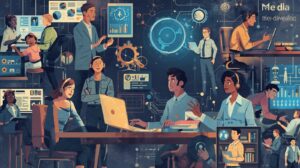
Real-World Story: Adapting to AI at Work
Consider a mid-level operations professional who was worried about losing their job due to automation. Instead of resisting change, they chose to investigate how AI tools may improve workflow efficiency. They subsequently evolved into a point of contact between technical teams and management.
This individual did not become a technical expert. They just learned how to use AI technologies and effectively exchange insights. As a result, their value increased rather than decreased. This story highlights a universal truth: the most important skill in the AI era is flexibility.
The Future of Jobs in an AI-Driven World
Human-machine collaboration will dictate the nature of jobs in the future. Roles will become more adaptable, skill-based, and focused on learning. Career pathways will be more dynamic and full of opportunities, but they may no longer be linear.
In actuality, individuals who are inquisitive, flexible, and eager to learn new things are the ones who will shape the future. Humans won’t be replaced by AI, but those who don’t want to learn could face difficulties. For this reason, educational platforms and processes need to change.
Artificial intelligence is something to comprehend rather than something to be afraid of. Simply said, AI turns into a potent instrument that enhances rather than jeopardizes human potential. Opportunities are growing while jobs are changing.
People may prosper in an AI-driven society by emphasizing learning, flexibility, and useful talents. With its learner-centered methodology, SkillsBiz Education equips individuals to confront the future with competence, clarity, and confidence.
In the end, machines won’t be replacing people in the workplace. It is about using technology to help people learn how to operate more intelligently.
FAQs
1. Is artificial intelligence going to replace all jobs?
No, AI will not replace all jobs. It will automate certain tasks but also create new roles that require human judgment, creativity, and communication.
2. Do I need technical skills to work in an AI-driven world?
Not necessarily. Basic digital awareness and adaptability are enough for most roles. Platforms like SkillsBiz Education help learners build these skills without technical complexity.
3. Which jobs are most affected by AI?
Jobs involving repetitive and rule-based tasks are more affected. However, roles requiring problem-solving, creativity, and empathy remain highly valuable.
4. How can I prepare for AI-related job changes?
You can prepare by continuously learning, improving soft skills, and understanding how AI tools support your role rather than replace it.
5. Is AI only for large companies?
No, AI tools are now accessible to small businesses and individuals, creating opportunities across all levels of the workforce.
6. How does SkillsBiz Education help with AI readiness?
SkillsBiz Education focuses on practical, beginner-friendly learning that helps individuals adapt to AI-driven changes and remain career-ready.