


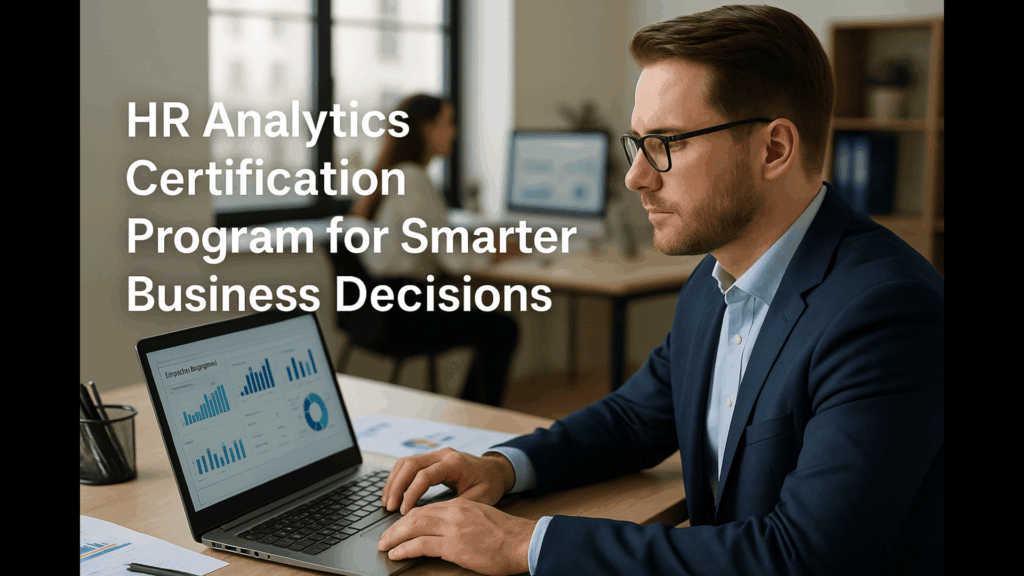
Organizations today are utilizing data-driven methods for everything from performance management to reducing employee turnover, and many businesses have begun using Human Resources (HR) Analytics as one of their key tools in evaluating performance, productivity, and costs of their employees as well as employees’ engagement and talent outcomes.
HR Analytics is a career path that is both growing in popularity and also serves as a significant tool to empower businesses. Organizations now require their HR departments to gain an understanding of data models, business metrics, productivity trends, and other predictive insights which will impact corporate leaders’ decisions. This increased requirement has provided an increasing demand for HR professionals who possess both HR expertise and analytic skills. An HR Analytics Certification Program will provide the knowledge needed to bridge the gap between HR expertise and analytic intelligence by providing individuals with knowledge about workforce analytics, reporting tools, dashboard development, and strategic decision-making.
The business impact of HR Analytics reaches far beyond the traditional HR functions. Along with positively impacting an organization’s ability to forecast revenue and expense budgets, HR Analytics impacts an organization’s ability to improve customer satisfaction, increase operational efficiency, and enhance long-term profitability and brand strength. When organizations have insight into their workforce patterns, they are able to effectively improve business performance.
How HR Analytics Strengthens Business Performance
The success of a business in today’s competitive environment is primarily based on its workforce’s quality and stability. By utilizing HR analytics, organizations can better understand exactly how to allocate resources for optimal performance by making the leap from simply using “gut” instinct or guesswork to developing a data-driven approach to analyzing employee performance, employee engagement levels, absences, retention rates, recruitment efficiency, and skill gaps within their current workforce. Data analytics provides businesses with clarity regarding what factors drive employee performance within their organization.
With the help of these analytics, business leaders are able to answer key questions such as:
- Which departments have the highest turnover rates and what is the reason behind that?
- What skills are going to be needed in 12 months as the marketplace continues to change and evolve?
- How closely does the money spent on employee training correlate to improved productivity and performance?
- What are the most effective recruiting avenues for hiring top quality employees?
The use of HR analytics allows business leaders to make better strategic decisions about their organization’s staffing needs, calculate the return on investment regarding HR-related business investments, and understand employee behavior. This leads to more strategic cost reductions, increased productivity, and long-term growth potential for the business.
Business Applications of HR Analytics That Drive Value
1. Predictive Workforce Planning & Analytic Forecasting
When businesses utilize predictive analytics to identify their future hiring requirements, estimate their workload for recruiting, and determine an employee’s best fit for the organization. It allows the business to be more accurate about its business plan. HR Predictive Analytics provides information about patterns that enable businesses to prevent being understaffed, overstaffed, or lacking the right skill set.
2. Improving Talent Acquisition Through Data
Through understanding where high-performing employees come from, businesses are able to leverage this information to minimize recruitment costs by simplifying their hiring process and developing high-performing teams more quickly.
3. Performance Management Insights Through Analytics
Through the use of HR Analytics, businesses are able to create performance management systems that are fair, transparent, and measurable. HR Analytics allows businesses to identify their top performers, identify reasons why a person may not be as productive as expected, and to design training programs that produce the greatest positive impact on performance.
4. Employee Engagement & Turnover Through Analytics
Employee turnover is detrimental to business continuity, brand reputation, and internal company culture. Analytics allows businesses to identify the causes of employee disengagement, enabling them to create experience-driven retention plans that support employee stability.
5. Measuring Training ROI
Training is often viewed as a cost center. Through using HR Analytics to track the results of training on employee performance. HR Analytics allows businesses to define where they are likely to get the greatest return on their investment in training, improving productivity, increasing effectiveness, and reducing errors.
6. Salary Benchmarking and Compensation Analysis
Salaries can have a significant impact on an employee’s likelihood of leaving the organization due to compensation and satisfaction. A business can compare its compensation structure to industry standards and may be able to create a competitive pay structure by using HR Analytics.
Why HR Analytics Certification Matters for Business Professionals
HR Analytics Certification Programs are designed to give you the technical expertise and strategic insight to analyze HR data so that you can make decisions about people based on that data. Through coursework in the area of workforce metrics, data visualization tools, dashboards, predictive analytics and modeling techniques, you will learn how to analyze the body of information available to HR departments and use it effectively.
In addition to HR professionals being able to interpret HR data, this knowledge will also benefit business leaders, managers, consultants and entrepreneurs because HR analytics directly affects how effectively a business operates, its financial planning and recovery, and its ability to sustain itself as a viable entity.
Interpreting HR data is critical in developing sharper insights into:
- Anticipating risks related to your workforce.
- Creating data-driven HR strategies.
- Improving the effectiveness of your recruitment efforts.
- Enhancing the performance of your teams.
- Strengthening your organizational culture.
Completing an HR Analytics Certification will give professionals entering the business world an advantage over others who do not complete a certification because they have the ability to communicate their findings with hard evidence. Today’s employers prefer employees who can combine analytical thinking with strategic thinking.
Real-World Business Scenarios Where HR Analytics Makes an Impact

Reducing the cost associated with hiring talent for fast-growing organizations
Organizations that are growing quickly (like startups or companies that are increasing their size) tend to spend more than they should on hiring personnel because there is typically a great need to find people and an additional problem with finding qualified candidates due to poor sourcing methods. Utilizing HR analytics will determine the right methods to use to reduce your organization’s recruitment budget while not compromising on the quality of the talent that is hired.
Increasing employee productivity in the manufacturing and retail environments
When working with a large number of employees, there should be consistent checking of employees’ productivity. By utilizing workforce analytics, businesses can clearly identify productivity patterns, skills that are lacking in their workforce, and training needs that will improve the operational performance of their entire organization.
Support during your organization’s digital transformation
Organizations that implement new technology, such as automation or other forms of technology, will generally experience resistance and expect that their employees will not possess the proper skills related to that technology. Utilizing workforce analytics provides employers with data that will help to identify employee training needs related to the implementation of the new technology as well as the progress made by their employees regarding the adoption of that technology.
Supporting a more diverse and inclusive workplace
Companies today strive for a diverse and inclusive workforce among employees, since diversity provides greater potential for creative thinking, innovative problem-solving, and increases brand value. By utilizing HR analytics, employers can measure their organizations’ diversity and inclusion policies through tracking related metrics and determining any gaps within their workforce.
A Practical Guide to Choosing the Right HR Analytics Course
The ideal HR Analytics Certification Program would encompass an idealized understanding of great HR Analytics techniques as well as provide opportunities for real-world application through hands-on training. HR Analytics Curriculum would include Analytical Tools like Microsoft Excel, Power BI, Tableau, Python, HRMS Dashboard Projects and other Forms of Analytical Software. In addition, Case Studies and Real Life Application of Analytics should also be included.
Learners should consider the following when selecting a Course:
- Descriptive and Predictive Analytics Teaching Methods
- Practical Dashboard Examples that are publicly available
- Flexible scheduling for those working full time
- Mentorship from an Experienced Mentor
- Industry Certified Value of Certification
How SkillsBiz Education Supports Career Growth in HR Analytics

SkillsBiz Education offers educational programs that are structured to support working professionals when transitioning into the field of HR analytics. They look at how talent metrics can be interpreted through various lens’ (Dashboards, Talent Insights, Workforce Trends) to develop students with job-ready competencies which reflect the expectations of businesses today.
Thus they are also able to keep pace with the fast-paced nature of business and the HR function where analysis of workforce data has become indispensable in order to make strategic decisions throughout the entire organization.
Future of HR Analytics in the Business Ecosystem
As technology and data science evolve in the way they assist companies with their operations, the future of Workforce Strategy will be based on numerous new predictive HR models, AI-enabled Hiring Tools, Performance Analytics and Employee Wellbeing Data.
To be effective in meeting these challenges, companies need professionals with an understanding of both the Human Behavior and the Analytical Models associated with HR Analytics.
HR Analytics Certification Programs provide individuals with the foundation needed to make this transition, thereby enhancing their ability to contribute to achieving business objectives.
FAQs
1. What is HR Analytics and why is it important for business?
The use of HR Analytics can help improve. The way an organization hires and retains staff, improves productivity and uses strategic planning.
2. Who should join an HR Analytics Certification Program?
HR professionals, business managers, those who enjoy working with data, and anyone involved with workforce-related arguments.
3. Is a technical background required to learn about HR Analytics?
Most programs start out with an introduction to HR Analytics and build upon it to allow you to develop skills. Interpreting and using data as well as creating dashboards and creating predictive analysis.
4. How can you improve business performance by using HR Analytics?
By providing valuable information that supports decreasing costs, optimizing hires, increasing retention rates, increasing productivity and supporting strategic decision-making.
5. Can small businesses benefit from using HR Analytics?
Yes, HR Analytics provides small businesses with ways to monitor. Manage talent, reduce turnover and waste in budgeting, and create better teams.