


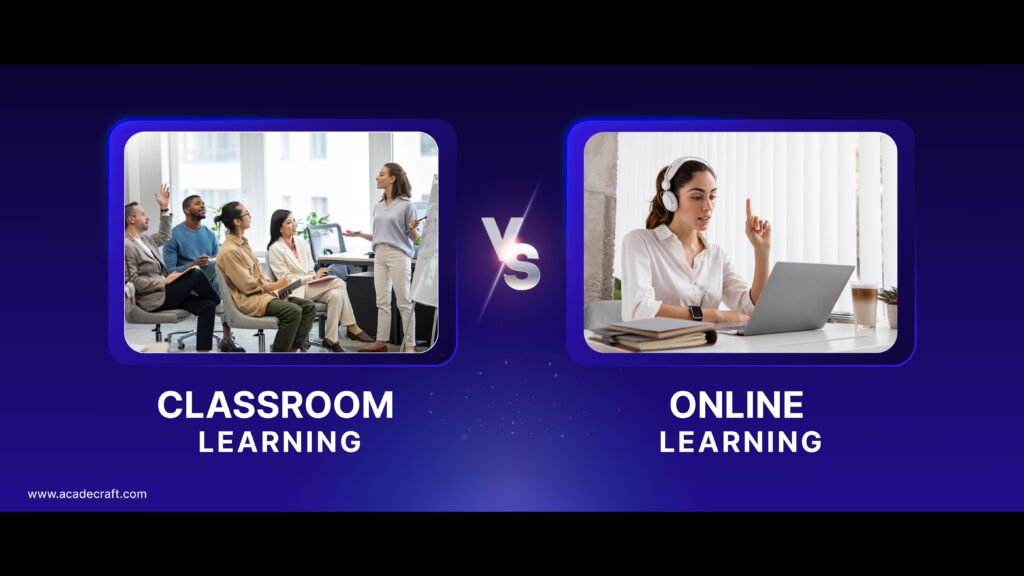
The way people conducted business has changed drastically over the course of the last ten years, as have the ways they develop themselves personally and professionally through education and training. While classroom learning has always had its niche, with the unprecedented speed of today’s society and economy, it is more important than ever to have flexible options for education, to be able to access training rapidly, and to have the ability to connect without geographical boundaries. Online education has become a very viable alternative to the traditional classroom environment, with it continuing to evolve with society and the economy.
For instance, if you’re a working professional looking for a definite career advancement, an entrepreneur wanting to develop your skills for superior management or leadership within your organization, or a recent graduate looking to join a highly competitive job market, the online education environment provides many avenues that were not available to you through traditional education.
In this blog, we will look at how online education is superior compared to traditional education, how this affects business professionals, and which are the best online educational institutions that offer quality training programs to help individuals develop their careers.
Why Modern Business Professionals Prefer Online Education
The business world relies on speed, adaptability and innovation. While offline learning is worthwhile, it does not always keep pace with the rapid growth and change that businesses undergo each day.
1. Accelerated career development through flexible scheduling
Many business learners are juggling many activities—working on projects, meeting deadlines, attending meetings, fulfilling personal obligations, etc.—while they are continuing their education. Online education allows business learners to learn at their own convenience.
- Anytime, whether it’s early morning or late at night.
- Anywhere, without having to commute to school.
- At their own pace, which allows them to fully absorb the material and gain a deeper understanding.
The flexibility of online education makes it the preferred choice for many managers, analysts, marketers, HR professionals, and entrepreneurs.
2. Updated curriculum that stays abreast of industry trends
Typically, offline colleges will take several months or years to update their curricula. Online platforms provide learners with access to continuously updated educational content that reflects the current business environment with respect to:
- The most current Business/Organization Frameworks
- Emerging Technologies
- Market changes and shifts
- What Employers are looking for
By providing current information about the latest trends in their industry, learners will be better prepared to make informed decisions and take steps toward furthering their careers.
3. A more affordable method of obtaining quality education
Education received through offline methods has many hidden costs such as transportation, printed materials costs, physical infrastructure fees, and numerous additional costs that are attached to most offline programs. Online programs remove these additional costs from the overall price of obtaining a quality education and therefore allow business learners the opportunity to obtain a high-quality education, at an affordable price, without sacrificing quality or expertise.
4. Real-world case-based learning/experiencing quality instruction from Industry Experts
Most online business courses offer business learners the ability to learn from experienced faculty who are located around the world. This access to:
- An International Perspective
- Case Studies of businesses operating in the business.
This exposure remains limited in most offline settings due to location constraints.
How Online Learning Supports Business Skill Development
Business success requires a unique combination of analytical, strategic, and interpersonal skills. The structure of digital learning allows for a better development of these skills compared to traditional classroom environments, thereby providing an advantage for professionals who complete their degree programs via online education.
1. Increased Decision Making Ability
With the integration of data-driven modules and scenario-based learning activities, online education provides learners with the tools to help them learn about:
- Assessing risk
- Financial impacts
- Strategic planning
- Understanding Customers
Micro-learning tools support learners by simplifying complex concepts and enabling a practical understanding of these skills.
2. Enhancing Communication and Leadership Capabilities
Online education has also provided platforms for learners to communicate with their peers. Through online forums, group projects and virtual teamwork, learners are encouraged to:
- Develop critical thinking skills
- Improve corporate or business communication
- Collaborate/work as a team
- Build confidence in leadership roles
3. Fostering a Culture of Lifelong Learning
In the rapidly changing business world resulting from digital transformation, artificial intelligence and globalization, online education promotes ongoing learning by:
- Creating short certificate courses
- Offering specialized career-oriented programs of study
- Creating recorded learning materials that can be viewed multiple times
- Providing lifetime access to many online education providers
Cultivating an environment where ongoing development and continuous improvement occur will lead to the longevity of businesses.
The Rise of Online Institutes Providing High-Quality Business Courses
India has many reliable online providers of business courses/education.
1. Coursera – www.coursera.org
Provides access to courses from top worldwide universities like Stanford, Wharton, and Yale. This provider is ideal for learners seeking careers as business analysts, as well as business leadership and management.
2. Udemy – www.udemy.com
This is a flexible, low-cost online provider that offers hundreds of business-related courses, such as marketing, entrepreneurship, human resources, and project management.
3. LinkedIn Learning – www.linkedin.com/learning
LinkedIn Learning provides a professional training program that has been designed specifically to help accelerate or improve careers. Topics covered in these courses include strategy, communication, finance, and managing people.
4. edX – www.edx.org
EdX provides online courses developed by some of the most prestigious universities in the United States including MIT and Harvard. These online courses cover such areas as corporate strategy, financial analysis, and business management.
5. SkillsBiz – www.skillsbiz.com
SkillsBiz Education is trusted provider of work-related educational programs, including SAP, Six Sigma, Data Analysis, and Business Skills. This provider is a popular choice among learners due to its structured approach to providing online courses, practical application of course material, and experienced instructors who have experience working in the related fields.
How SkillsBiz Education Fits Into the Online Learning Evolution
SkillsBiz Education’s Approach to Practical Business Learning
Students looking for hands-on and ready-to-work skills in Business and Management can benefit from SkillsBiz Education. All of their programs are delivered exclusively online and include:
- SAP modules in many different industries
- Six Sigma methodology to advance Business Processes
- Data Analytics to support modern decision making
- The skills used to support Business Development
All of their courses have been designed around the needs of today’s businesses; to be flexible, practical and accessible. Their Trainers, who have many years of Industry Experience, help to simplify highly technical areas for both novice and experienced Professionals.
Why Online Education Is Better Than Offline for Business-Focused Learners
By comparing the two course delivery options, we will better understand the changes taking place:
1. Online courses offer speed – offline courses offer stability.
In today’s business world, speed dominates. Online courses are updated immediately and can provide you the latest tools and frameworks sooner than offline institutions.
2. Online courses remove barriers – offline courses create barriers.
A student living in Pune can connect with a professor at Harvard University with the click of a button. Distance limitation, class schedules, and teacher availability create limits in offline education.
3. Online courses promote self-discipline and independent thinking.
Success in the business world requires that individuals be self-motivated and driven by success. Online courses foster this mentality through their very nature.
4. Online education promotes computer literacy – a critical skill for the business world.
Successful business professionals use dashboards to collect and analyze data. Therefore, online courses create an environment of technological readiness for business.
5. Online education provides networking opportunities across the globe.
Online learning doesn’t just connect students within their own countries. It provides networking opportunities with students in every country through forums, live sessions, and virtual groups. Networking on a global scale is not typically provided in traditional classroom environments.
FAQs
1. What are the advantages of using online business education?
The benefits of using an online education include current and updated content relevant to the industry, access to a global learning community, and the ability to learn on your own timetable.
2. Will I be able to depend on an online education for everything that you would traditionally get from a business degree?
No. The only thing that an online education can provide is online business certifications that will allow you to gain experience faster than traditional methods.
3. Can you use an online certification when applying for jobs?
Yes. Recruiters are looking for certificates from reputable sources such as Coursera, edX, LinkedIn Learning, and SkillsBiz Education.
4. What should I consider when looking for an online school for business courses?
When looking for an online business institution, find out the curriculum quality, faculty background, the type of hands-on projects, student reviews, and relevance to the industry.
5. Are online courses good for people who have never taken a business course before?
Definitely. Most online programs start with beginner-friendly modules, which makes it easy for you to build your actual business foundation at your own speed.